
UK Small Business Bookkeeping Is a Six-App Problem. It Shouldn't Be.
Here's what a typical month looks like for a small UK business owner who does their own books.
The bank statement gets exported to a spreadsheet, or copied line by line if the bank doesn't cooperate. Credit card spending gets sorted into a separate sheet, with a mental note (rarely written down properly) about which purchases were actually personal. Payroll, if there's a single employee, lives in yet another tool, or a formula someone half-remembers from last year. VAT gets calculated by hand or estimated, then submitted through HMRC's own portal, assuming the Making Tax Digital software requirement has actually been dealt with. Self Assessment happens once a year in a scramble. And at year-end, all of it gets handed to an accountant as a folder of exports, who has to reconstruct a coherent picture from six inconsistent sources before they can even start on the actual accounts.
None of this is because small business owners are bad at bookkeeping. It's because the tooling assumes you'll stitch together your own system out of a spreadsheet, a bank app, a payroll subscription, and a government portal — and then it's surprised when things fall through the cracks.
Making Tax Digital raised the stakes
HMRC's Making Tax Digital programme was meant to modernise this. In practice, for a lot of small businesses, it just added a compliance requirement on top of the existing mess: VAT-registered businesses already need MTD-compatible software to file, and Income Tax Self Assessment is following the same path. That's not optional software hygiene anymore — for a growing number of businesses, it's a legal requirement for how you're allowed to submit figures to HMRC at all.
Which means the six-tool problem isn't just inefficient. It's now a compliance risk. A number that's off by a hundred pounds because it moved through three spreadsheets and two manual re-entries isn't a rounding error — it's the number that goes to HMRC.
What that actually costs
Ask anyone who's done their own bookkeeping what the worst part is, and it's rarely the arithmetic. It's the reconciliation — realising in March that a category was wrong since August, or that a personal card purchase never made it into the Director's Loan Account, or that last year's tax bands were still sitting in a spreadsheet formula that should have updated in April.
Those aren't rare mistakes. They're the predictable result of a workflow with too many handoffs between too many tools, none of which know what the others did.
One place, connected to the two places that matter
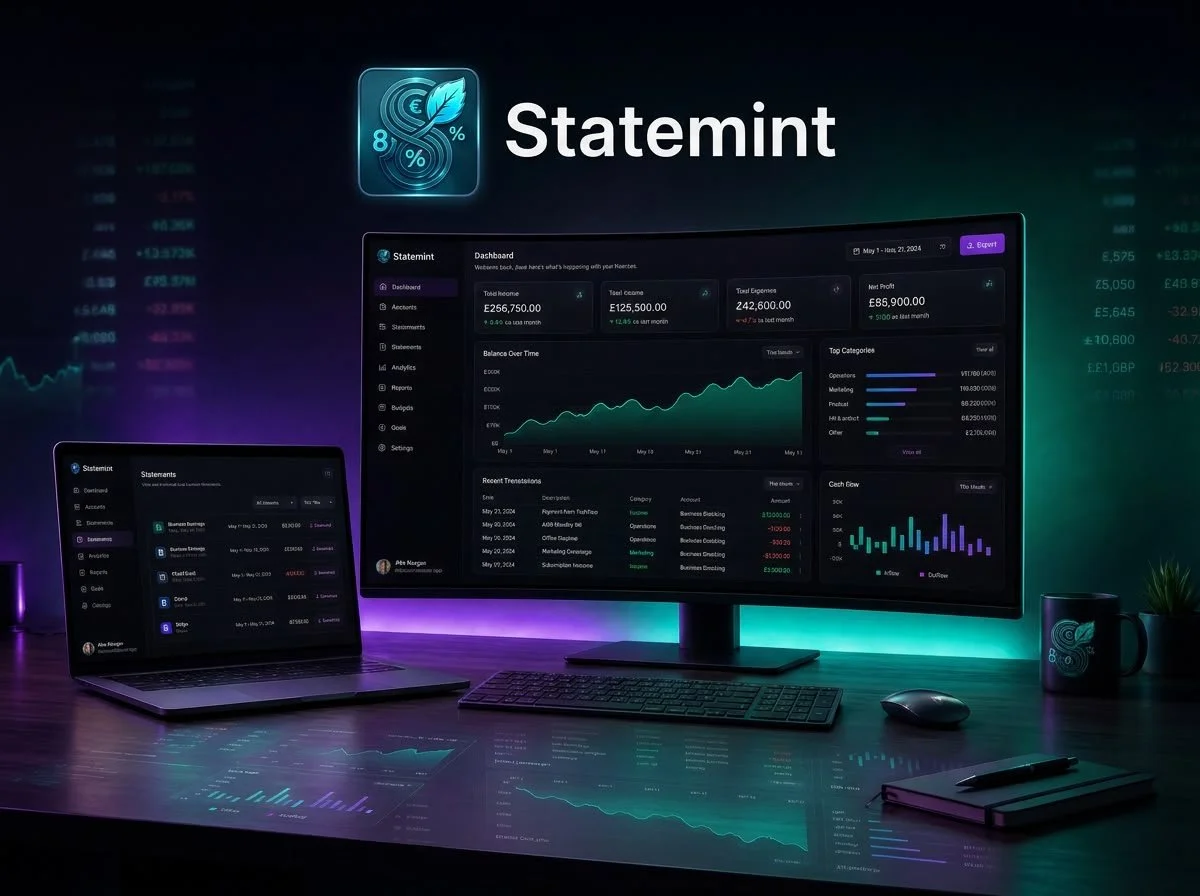
Statemint exists because that workflow shouldn't need six tools. It's a single desktop app — for UK limited companies and self-employed sole traders — that handles bookkeeping, payroll, VAT, Corporation Tax, Self Assessment, and year-end accounts in one place, and connects directly to the two systems that actually need the final numbers: HMRC and Companies House.
The reconciliation problem gets solved by not creating it in the first place. Bank and credit card statements import directly, with AI doing the first pass at splitting business from personal and suggesting categories. A personal purchase on a business card doesn't need a separate spreadsheet note — it flows straight into the Director's Loan Account automatically. Payroll runs against tax year rates that Statemint can fetch and validate on demand, so April's updates don't depend on someone remembering to change a formula.
And when it's time to actually file — VAT return, Self Assessment, Corporation Tax — Statemint submits directly through HMRC's Making Tax Digital APIs, or exports a proper printable form if you'd rather review it with an accountant first. Companies House filing history, officers, and deadlines are visible in the same app, not a separate login.
Year-end doesn't start from a folder of exports. It starts from data that was already reconciled every month, with a statutory Profit & Loss, an independently cross-checked Balance Sheet, and an FRS 102 disclosure checklist that answers what it can from the numbers already on file.
Who this is actually for
If you're a sole trader or a small limited company handling your own books, Statemint replaces the spreadsheet-plus-portal patchwork with one system that already knows what it's talking to.
If you're an accountant or bookkeeper managing several clients, it replaces the same patchwork multiplied by every client you have — with proper multi-client management and exportable client packages instead of a folder per client on your desktop.
Either way, the point isn't "another app to learn." It's one app instead of six, built specifically around how UK tax compliance actually works — because the number that goes to HMRC deserves better than a formula nobody's checked since last April.